Our trip to holland’s tupip festival
We took this trip from April 26 through May 4, 2026, visiting at what appeared to be the tail end of the peak season this year. Timing a tulip trip is famously difficult as bloom windows shift every year based on winter temperatures, rainfall, and sunlight, and even locals cannot predict perfectly (although some certainly claim to, just all with different claims) with certainty when fields will be at their absolute best. Still, late April and early May remain a fantastic time to visit the Netherlands. The fields were very much alive with color and the country feels as if it’s starting to awake after winter with long daylight hours, open-air cafés, plenty of bikes (although the winter doesn’t stop the Dutch from this), and a full calendar of seasonal events.
Tulips are deeply associated with Dutch identity, but not in the way that I had originally thought. The Netherlands is home to bulb farmers, not flower farmers. The blooms that blanket the fields each spring are not the final product. They are a temporary stage in a much longer agricultural cycle. After a short display period, the flowers are cut off so the plant can redirect its energy into the bulb underground. This allows the bulb to grow stronger and larger before it is harvested later in the summer. Seeing entire fields of flowers removed can feel abrupt and, for tourists like myself, really quite sad. However, farmers were good to teach everyone that this practice is essential to maintaining the Netherlands’ position as the world’s largest exporter of flower bulbs.
Tulip cultivation here dates back to the late 1500s, when bulbs arrived from the Ottoman Empire and quickly captured the imagination of Dutch society. By the early 17th century, tulips had become the center of one of history’s earliest speculative bubbles, known as Tulip Mania, where rare bulbs were traded for prices equivalent to canal houses today. This coincides well with Amsterdam’s trading and financial focused history of markets (home to the first stock market in the world). While the market eventually collapsed, tulips never lost their cultural importance. The only pause occurred during World War II when flower production was forced to be stopped as farmland was converted to food crops out of necessity. Stores of the Hunger Winter of 1944 and 1945 where tulip bulbs were even consumed as a last resort were told at many information points. After the war, tulip farming returned in a more organized, export-focused form that laid the groundwork for the modern industry.
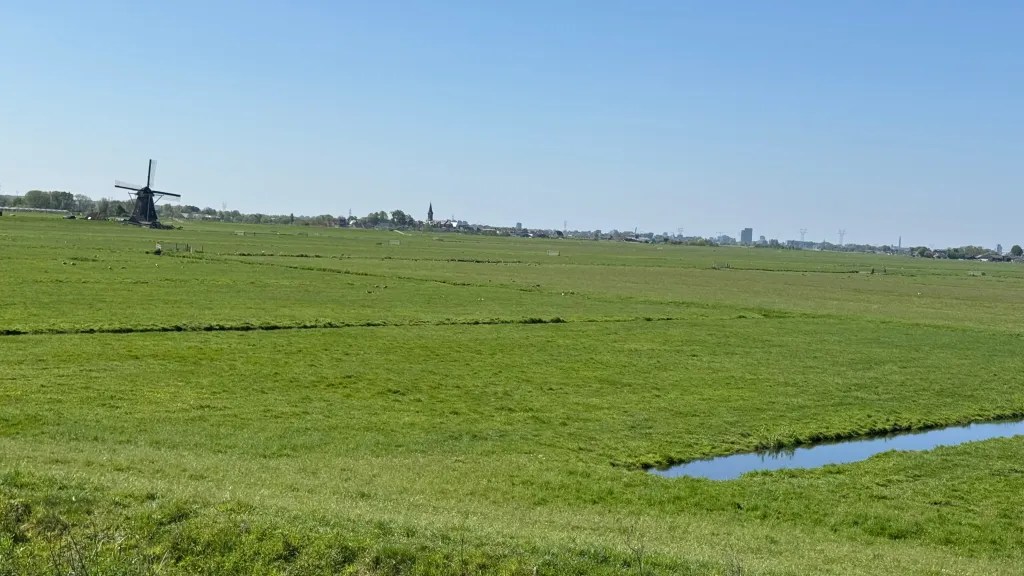
The geography of the Netherlands is a major reason tulips thrive here. Much of the country sits at or below sea level and exists only because of centuries of land reclamation. Through an intricate system of dikes, canals, and pumping stations, water is carefully controlled, and farmland is kept dry and fertile. This is why you see so many windmills, most of them with the sole purpose of pumping water out of the ground to reclaim land for crops and livestock. Amsterdam itself began as a small settlement around a dam on the Amstel River and expanded as surrounding wetlands were drained and stabilized. The flat terrain, sandy coastal soil, and easy access to water create ideal growing conditions for bulbs, particularly in regions like the Bollenstreek between Haarlem and Leiden, about 30 minutes south of Amsterdam by train, where today’s Tulip Festival is hosted.
The modern tulip festival is synonymous with Keukenhof Gardens , curated perfectly and designed to showcase the varieties of tulips at peak bloom, while the surrounding countryside reveals tulip farming at scale, with long, geometric fields best explored by bike. Add in historic windmills, canal cities, world class museums, and a food scene that quietly exceeds expectations (drawing on Indonesian ties during the exploration period), and spring in the Netherlands becomes a well rounded itinerary that extends far beyond the flowers themselves.
Why and when visit amsterdam during the tulip festival

For us, the appeal of visiting during tulip season was never about perfectly timing peak bloom, especially since that goal feels nearly impossible. Tulip season in the Netherlands typically lasts only four to six weeks, roughly from late March through early May, with true peak bloom often confined to a much shorter window that shifts every year based on weather. You can check forecasts in early January to try and time better if you have flexibility but, rather than chasing perfection, we focused on choosing a time that offered the best overall experience. We have found that we enjoy European cities most when they are paired with a seasonal event (e.g. Munich during Oktoberfest) where you get both the depth of the city and the energy of a specific moment in time. We also have found that May continues to be our favorite time to travel to Europe, with comfortable weather, manageable crowds, and airfare prices that tend to stay lower before U.S. summer travel ramps up, but late enough that everything is fully open for the season. With those two variables in mind, that is why we chose to go to visit Amsterdam for the first time during Tulip season at the time we did.
the daily sight, bite, highlight:
In order for each day (1-7) these were the sight, bite, and highlight of each day. Some days had delights and frights this trip, all of which is expanded on in the detailed itinerary.
| Sight | Bite | Highlight |
|---|---|---|
| The Play that Goes Wrong @ Duchess Theatre London | Afternoon Tea in the Palm Court at the Langham | Energy of the London Marathon |
| Canals of Amsterdam | Creative Modern & Verlan | Amsterdam Free Walking Tour |
| Keukenhof Garden | Rijstaffel @ Tujuh Maret | Tulip Bulb Farm in Lisse |
| Zaanse Schans | Restaurant De Kas | Countryside Bike Tour w/tour of working windmill |
| Tulip Fields in Bollenstreek | Fresh Stroopwafel | Biking around the Tulip Farms |
| Bruges City Center Walking Tour | Belgian Frites | Wandering Bruges: Small bridges, chocolates, parks |
| Borough Market | Bao Mary | Football Match @ Emirates Stadium |
Travel and accomodations
Air & Destination travel
Arrival: Although Amsterdam was the primary destination for this trip, we chose to fly into London Heathrow after finding a strong points and miles redemption on a nonstop flight from Salt Lake City. London is an easy and efficient gateway to Amsterdam, with direct high-speed train service connecting the two city centers in just a few hours. We also love London, so starting the trip there allowed us to spend our first day enjoying the city before continuing on to the Netherlands.
Departure: We departed from London Heathrow at the end of the trip, returning after several days in the Netherlands and Belgium. Getting to Heathrow is now significantly easier thanks to the “Lizzy Line”, which runs directly from central London to the airport and eliminates the need for the Heathrow Express. While Heathrow remains a less-than-ideal airport to depart from, being prepared makes a big difference. Liquids must be packed in a small clear bag, seating in the main terminal is limited, and having lounge access is well worth it. Primeclass is our favorite Priority Pass lounge at Heathrow, with No1 also being a solid option, and the Centurion Lounge is a great choice for those with access (plat card).
Travel Between Destinations: We traveled entirely by train between destinations on this trip. High-speed and intercity rail connected London, Amsterdam, Bruges, Brussels, and back to London, and all long-distance tickets were booked in advance through either Eurostar or the NS International app. The TrainLine app was less helpful for this trip, but still good to have in case. Local travel within London was handled using contactless tap to pay on the Tube, and we did not use trams in Amsterdam since our hotel was within walking distance of nearly everything we wanted to see. International train travel on the Eurostar, although not as bad as airports, does require you arrive early since Brexit. Be warned, you will need to wade through long lines, and you will wait. I recommend getting there early, as recommended by Eurostar in your pre-departure email. We found Brussels to be, at the time, much more chaotic than St. Pancras.
| Departure | Arrival | Duration | Type / Notes |
|---|---|---|---|
| London St Pancras | Amsterdam Centraal | 4hrs | High speed Eurostar (reservation req.) ~$60-100 |
| Amsterdam Zuid | Brugge | 2hrs 50min | EC Direct → Antwerpen Central | IC → Brugge (Can book via NS International) |
| Brugge | London St. Pancras | 3hrs 45min | Belgian IC → Brussels Midi | Eurostar → London. ~$130 |
| Central London | LHR | 30min | Elizabeth Line (Tap on Tap off) $15 |
Transfer Partners for Neutral Currencies: For this trip’s flights, I leveraged Virgin Red as a transfer partner from Capital One to book Delta Airlines flights (roundtrip) in and out of London. This is a primary reason we went to London vs. Amsterdam and how I’ve pad for our flights to England each time we’ve gone. Steps below:
- Virgin Atlantic participates in a points program called “Virgin Flying Club” which is tied directly to “Virgin Red” loyalty program. Now, Capital One allows you to earn capital one miles through spend. I use the Venture X primarily, which earns 2x per every dollar spent. There are additional rewards like 5x for flights and 10x for hotels but only when you book through capital one, which I don’t do as often. You can redeem these capital one miles for 1 cent per mile toward travel purchases OR you can transfer them (typically 1:1) from your capital one account to another reward account.
- The transfer partners (accounts you can transfer to) is limited and found here
- Virgin Atlantic is part of SkyTeam alliance. There are 3 main alliances that most airlines in the world are a part of (the other two are One World and Star Alliance). SkyTeam is also the home to Delta Airlines, which means that you can book Delta Airlines flights via Virgin Atlantic’s website.
- Most of the time, I’ve found flights from SLC to LHR for 25 – 30,000 miles round trip. So, first I confirm that the flight exists because Virgin isn’t allowed to sell all flights the Delta flies, and availability is more open the further out… just not too far out. Look about 4-6 months ahead.
- Once I confirm the flight, it will tell me who operates the flight (e.g. Delta Airlines). I then transfer the miles from capital one to my virgin red account, which is linked to my virgin flying club account. The transfer happens instantly.
- Now, with the points in my virgin account, I can go ahead and book the flights. You do have to pay fees which, unfortunately for LHR they are the highest in Europe. So, typically about 25,000 – 30,000 miles + $300 – 500 gets a round trip flight on Delta to London. I figure that this saves me about $500 – $600 dollars. Thus, the value of the 30,000 miles = about 2 cents per mile (double the standard one cent) and that is why you do it.
- Once booked, I go into the reservation in my Virgin account and change the loyalty program number to be my SkyMiles number. On award flights, you will NOT earn extra miles. However, you may earn MQDs and also have it easier to track being tied to Delta.
- If you were wondering, yes – this strategy works for domestic flights as well. You can book flights from SLC to LAX for example via virgin for as little as 5,000 miles. So, recommend checking that before booking (although not always available!)
Accomodations:
I typically prefer to have a home base and go from there. For this trip, we did have to position from London to Amsterdam. However, once there we stayed in the same Amsterdam hotel our whole time there and it was great! However, as always when we travel to Europe, navigating trains and cobblestone streets is easier when your luggage is on your back and we love our Cotopaxi bags for that.
If you would like to use my rubric for scoring or want more details on the categories, see the score card here or go to the ‘about’ page to learn more.
We stayed at 4 hotels, with my full review of each listed below:
My Final Score:
2.875
The Waldorf is a classic London hotel in every sense, sitting right on the edge of Covent Garden and the West End theatre district. The interiors lean traditional, with grand public spaces and a sense of old London that feels especially fitting for the neighborhood. Its central location made it easy to walk to theatres, restaurants, and the Thames, and it worked well as a comfortable bookend to the trip. Not to be confused with a Waldorf Astoria, this is just a standard Hilton brand 4 star hotel and large for a city hotel at 298 rooms.
| Hotel Name | The Waldorf Hilton, London |
| City | London, UK |
| 4.4 (4,372) – 1/26 | |
| Tripadvisor | 4.0 (6,744) – 1/26 |
| Rated | ★★★★☆ |
| Affiliation | Hilton. Booked via Hilton |
| Avg. Cost / Night (November) | $350 – $500 |
| Points | Y. Booked w/points. 80k Hilton. |
| SBH Rubric Categories | My Score |
| Shit Score | ★★★☆☆ |
| Postcard Proximity | ★★★☆☆ |
| Stroll Score | ★★★★☆ |
| Eye Candy Quotient | ★★★★☆ |
| Snack Attack | ★★★★☆ |
| Fuel Score | |
| Kitchen Cred | |
| Shower Power Hour | ★★★☆☆ |
| Outlet Olympics | ★★★☆☆ |
| Deck the Halls | ★☆☆☆☆ |
| Knockout Score | ★★★☆☆ |
| Facilities Flex | |
| Zen Zone | |
| You New Here? | ★★★☆☆ |
| Local Champion | ★★☆☆☆ |
| Nickle and Dime | ★★☆☆☆ |
| Welcome Committee | ★★★☆☆ |
| Maze Runner | ★★☆☆☆ |
| Bob the Builder | |
| No Ragrets | ★★★☆☆ |
My Final Score:
3.638
This modern hotel sits directly next to Amsterdam Centraal Station, making it one of the most convenient bases in the city. It is well suited for travelers arriving by train and for exploring Amsterdam on foot, we never had to take a tram or anything besides our legs. It is on the other side of the river so not optimal for the shit score – but great for postcard worthiness. The rooms are contemporary and functional, a rare find near old city centers and we had a great complimentary upgrade thanks to the hospitality of the hosts. It is 182 rooms which is one of the larger ones in the area, so large tour groups did come and go. They do not have an executive lounge. For a city hotel, this place is really, really well located, and the staff + breakfast topped off the high rating.
| Hotel Name | DoubleTree by Hilton Amsterdam Centraal Station |
| City | Amsterdam, NL |
| 4.3 (8,297) – 1/26 | |
| Tripadvisor | 4.2 (9,415) – 1/26 |
| Rated | ★★★★☆ |
| Affiliation | Hilton. Booked via Hilton. |
| Avg. Cost / Night (May) | $250 – $300 |
| Points | Y. Hilton, 60 – 80k |
| SBH Rubric Categories | My Score |
| Shit Score | ★★☆☆☆ |
| Postcard Proximity | ★★★★★ |
| Stroll Score | ★★☆☆☆ |
| Eye Candy Quotient | ★★★☆☆ |
| Snack Attack | ★★★☆☆ |
| Fuel Score | ★★★★☆ |
| Kitchen Cred | |
| Shower Power Hour | ★★☆☆☆ |
| Outlet Olympics | ★★★★★ |
| Deck the Halls | ★★★★☆ |
| Knockout Score | ★★★★☆ |
| Facilities Flex | |
| Zen Zone | |
| You New Here? | ★★★★☆ |
| Local Champion | ★★★★★ |
| Nickle and Dime | ★★★★☆ |
| Welcome Committee | ★★★★☆ |
| Maze Runner | ★★★☆☆ |
| Bob the Builder | |
| No Ragrets | ★★★★☆ |
My Final Score:
3.613
Hotel Dukes’ Palace is one of Bruges’ most iconic hotels, set in a former ducal residence within the historic city center the architecture and vibes are amazing. The property combines historic architecture with refined luxury, including a peaceful garden courtyard. Staying here added to the fairytale atmosphere of Bruges and made the short visit feel especially special. Although the kitchen could have been improved and breakfast cost about the same as the room rate itself, the spread-out nature of the hotel made it feel like you were in your own part of the town while still being very close and the staff were generally good to work with.
| Hotel Name | Hotel Dukes’ Palace |
| City | Freiburg im Breisgau, DE |
| 4.7 (2,331) – 1/26 | |
| Tripadvisor | 4.5 (4,453) – 1/26 |
| Rated | ★★★★★ |
| Affiliation | Independent. Booked via Capital One. |
| Avg. Cost / Night (May) | $250 – $350 |
| Points | N. |
| SBH Rubric Categories | My Score |
| Shit Score | ★★★★★ |
| Postcard Proximity | ★★★★☆ |
| Stroll Score | ★★★★☆ |
| Eye Candy Quotient | ★★★★★ |
| Snack Attack | ★★☆☆☆ |
| Fuel Score | |
| Kitchen Cred | ★★☆☆☆ |
| Shower Power Hour | ★★★☆☆ |
| Outlet Olympics | ★★☆☆☆ |
| Deck the Halls | ★★★★☆ |
| Knockout Score | ★★★★☆ |
| Facilities Flex | |
| Zen Zone | |
| You New Here? | ★★★★★ |
| Local Champion | ★★★★★ |
| Nickle and Dime | ★☆☆☆☆ |
| Welcome Committee | ★★★☆☆ |
| Maze Runner | ★★★★☆ |
| Bob the Builder | |
| No Ragrets | ★★★★★ |
My Final Score:
3.038
Lost Property is a newer boutique-style hotel located just behind St Paul’s Cathedral. Part of Hilton’s Curio Collection, it blends distinctive design with modern comfort. Despite its central location, it feels quieter than many London hotels, making it a comfortable place to stay. However, St. Paul’s Cathedral (although cool) is the only sight nearby, and the property is relatively inconspicuous from the outside. The design inside is great, but the rooms are small (expected for a city hotel), and it appears that an optimal stay hinges on having a good room, so status will help. Ultimately, hard to beat the price of this hotel for London though!
| Hotel Name | Lost Property St Paul’s London – Curio Collection by Hilton |
| City | London, UK |
| 4.6 (498) – 1/26 | |
| Tripadvisor | 4.9 (1,567) – 1/26 |
| Rated | ★★★★☆ |
| Affiliation | Hilton. Booked via Hilton. |
| Avg. Cost / Night (November) | $250 – $350 |
| Points | Y. Hilton – 70k |
| SBH Rubric Categories | My Score |
| Shit Score | ★☆☆☆☆ |
| Postcard Proximity | ★★☆☆☆ |
| Stroll Score | ★★★☆☆ |
| Eye Candy Quotient | ★★★☆☆ |
| Snack Attack | ★★★★☆ |
| Fuel Score | ★★★☆☆ |
| Kitchen Cred | |
| Shower Power Hour | ★★★☆☆ |
| Outlet Olympics | ★★★☆☆ |
| Deck the Halls | ★★☆☆☆ |
| Knockout Score | ★★☆☆☆ |
| Facilities Flex | |
| Zen Zone | |
| First Day? | ★★★★☆ |
| Local Champion | ★★★★☆ |
| Nickle and Dime | ★★★★☆ |
| Welcome Committee | ★★★★☆ |
| Maze Runner | ★★★☆☆ |
| Bob the Builder | |
| No Ragrets | ★★★☆☆ |
Itinerary

Day 1: Arrival & London


Overview of the Day
We’ve found that the first day after an international flight is best approached gently, but not passively. Rather than writing the day off entirely, walking around and easing into the city helps us reset while still making the most of our time. London felt familiar and comfortable right away, and arriving on a sunny day made it especially pleasant to be back. Afternoon tea gave the day a clear anchor point, while the rest of the time was spent wandering, settling in, and letting the trip begin at a manageable pace. London served as a bookend to this itinerary, an enjoyable place to start and end the journey, without being the central focus of the trip itself.
Sight: The Play that Goes Wrong @ Duchess Theatre
Seeing a show (in this case in the West End) is something we always enjoy major arts cities like London. London’s West End has been the heart of the city’s theatre scene for more than three centuries, with performances dating back to the seventeenth century. Centered around areas like Covent Garden, Soho, and Leicester Square, the West End developed alongside London’s growth as a cultural and commercial capital. Many of the theatres still in use today were built in the late nineteenth and early twentieth centuries, creating one of the most concentrated and historic theatre districts in the world. Seeing a show here feels less like a single event and more like participating in a long-standing tradition, where going to the theatre has been a central part of London life for generations. This time we saw “The Play That Goes Wrong” and it was a perfect arrival night choice. The humor leans heavily on clever writing and strong audience energy rather than anything that requires intense focus, which made it approachable even while fighting jet lag (a feat that I failed at a couple times during the show, admittedly). One tip worth sharing is to get the ice cream at intermission, which is part of the fun and very much worth it.
Bite: Afternoon Tea at the Langham
Afternoon tea at the Langham was one of the highlights of the day and something we would absolutely do again. Afternoon tea has long been a British tradition, dating back to the mid nineteenth century as a light meal between lunch and late dinners, and today it is typically presented as a leisurely experience with unlimited tea, sandwiches, scones, and pastries (don’t skimp on the clotted cream… one of the best things that the UK has given the world) over a set window of time. At the Langham, the experience felt refined but not stuffy, with thoughtful service and attention to detail throughout. A funny, but telling encounter was when the server brought by an individual cloth side table for handbags. I’m sure this is expected by many of the crowd sporting Luis Vuitton, etc. however, for this outing we just had one Lululemon crossbody bag to place on the stool. We got a kick out of it, but it did speak to the level of care regardless of what you were carrying that the Langham provided. For afternoon tea, Lululemon bag or LV bag, getting dressed up is expected and part of the experience. This ended up being a surprisingly perfect way to spend the first afternoon off the plane.
Highlight: London Marathon Energy!
We happened to arrive on the same day as the London Marathon without realizing it in advance, and that spontaneity ended up being the true highlight of the day. Streets near our hotel were closed, crowds filled the sidewalks, and the city felt noticeably more energized. Once hotel staff mentioned what was happening, we made our way toward the course and eventually the finish area, catching glimpses of runners and soaking in the atmosphere. The weather could not have been better, and the combination of sunshine, cheering crowds, and shared excitement gave the city a lively, celebratory feel. It was a great reminder that some of the best travel moments are the ones you never plan for, they simply happen when you are in the right place at the right time.
day 2: Amsterdam


Overview of the Day:
Day 2 marked the true start of the trip. After an early morning departure from London, we arrived in Amsterdam late morning and spent the rest of the day orienting ourselves to a city that feels more intriguing than immediately lovable. Amsterdam has a slightly mysterious quality to it, shaped by its history, reputation, and a long-standing culture of tolerance and relative religious agnosticism. Tolerance is something that locals would often emphasize when talking about this history of the city. Amsterdam neither promotes nor condones much. Rather, people have always generally been free to do as they wish (particularly if it makes the city a bit of money). Unlike many European cities, there is no single dominant cathedral anchoring the city center. Instead, the city unfolds horizontally along canals, neighborhoods, and narrow streets. This felt very much like a discovery and orientation day, getting our bearings and beginning to understand how Amsterdam works.
Sight: The Canals of Amsterdam
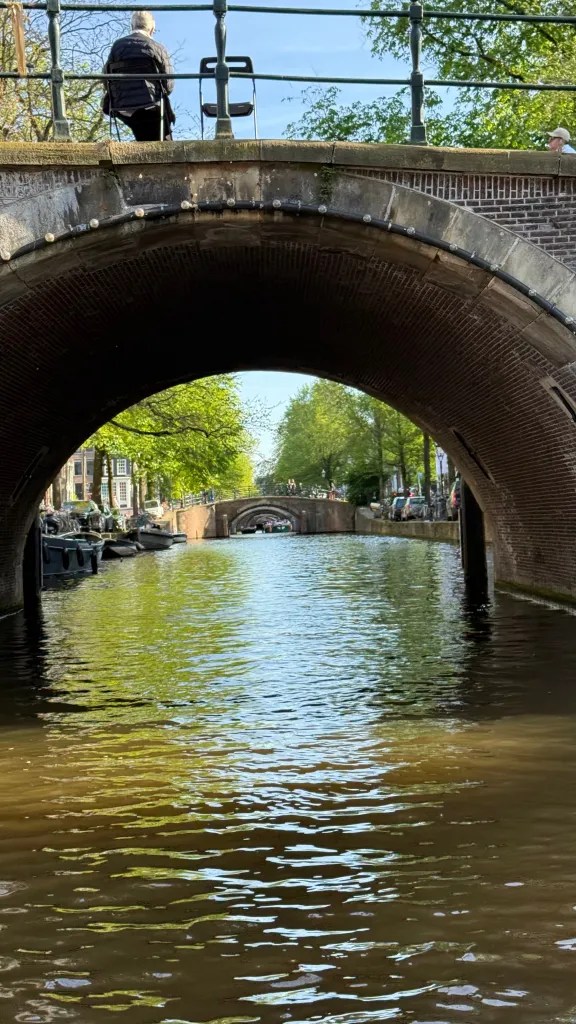
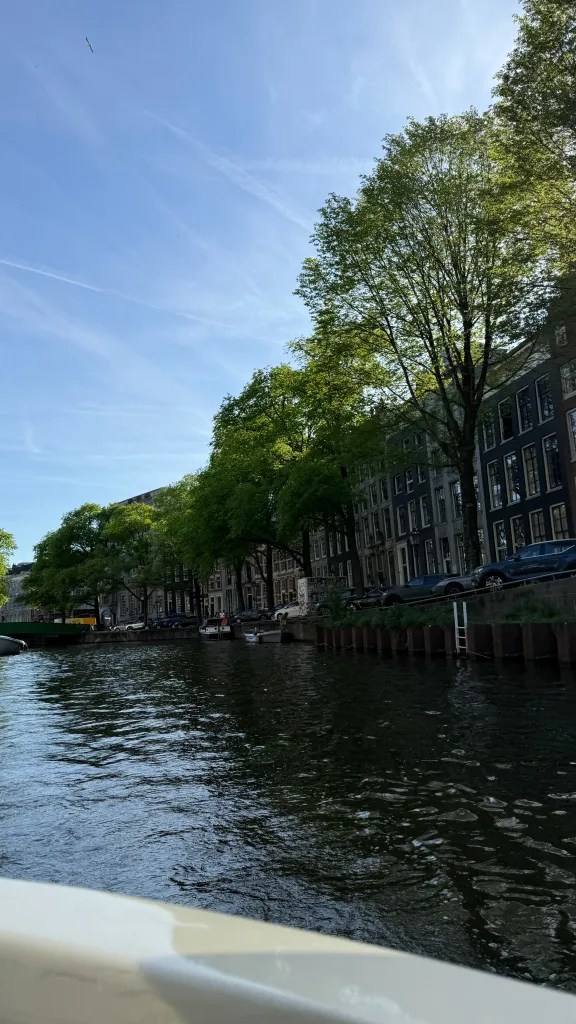
Amsterdam’s canals are as much an engineering achievement as they are a defining visual feature of the city. Built primarily in the seventeenth century during the Dutch Golden Age, the canal system was designed for water management, defense, transportation, and residential development all at once. The narrow canal houses that line the water are equally fascinating. Many of them lean noticeably, either due to settling over time on wooden pilings driven into soft ground, or intentionally, as a slight forward tilt made it easier to hoist goods up to upper floors using pully systems that are still visible on the rooflines and top floors. We also did a canal cruise, which is a fun and relatively inexpensive way to see the city from the water, though the best views of the canals are often from walking alongside them rather than floating through them. Even so, experiencing the canals up close feels like an essential first step when visiting Amsterdam for the first time.
Bite: Creative Modern at Cafe Verlan
The food scene in Amsterdam feels distinct from much of Europe, and not always in a straightforward way. There is a creative, slightly grungy edge to it, both culturally and aesthetically. It feels as though you’re in a modern renaissance of cuisine. Sometimes that experimentation really works, and other times it misses the mark. Our meals reflected that mix. While Cafe Verlan did not necessarily stand out as a culinary highlight, the atmosphere and creativity behind the restaurant, as well as the thinking behind the menu helped give us a perspective to Amsterdam’s evolving dining identity. For this reason, from a food perspective and cultural, I would not recommend Amsterdam as a first destination if you’ve never been to Western Europe before. It is more interesting once you have context from other cities, where the contrast makes its food and culture fascintating.
Highlight: Amsterdam Free Walking Tour
We almost always start our time in a new European city with a free walking tour, and Amsterdam was no exception. These tours operate on a tip-based system and are common across Europe, making them an easy and low-risk way to learn the basics of a city’s layout and history on the first day. In Amsterdam, the tour provided helpful context around the city’s trading past, its development during the Dutch Golden Age, and its long-standing culture of tolerance. A good example of tolerance comes through in the marijuana cafés, which operate legally in the Netherlands and consumption of marijuana is permitted under specific regulations (like calling your store a “cafe” instead of a weed shop) even though production remains technically illegal. So, due note: if you see a sign for a “Cafe” – this is not for coffee and a pastry. Having this background early on helped frame much of what we would see over the rest of our time in Amsterdam.
The Red Light District
The Red Light District is one of those places that is difficult to fully explain and something you ultimately need to experience for yourself. Located primarily along De Wallen near the city center, it operates openly in the evenings, while during the day it feels surprisingly ordinary, so much so that walking into the area at night you’re almost caught off guard that you suddenly are in the middle of the Red Light District. Legal, regulated sex work has been part of Amsterdam’s identity for centuries, historically tied to its role as a major port city. Seeing it both during the day and at night orients you to how it changes. I recommend seeing it first at night, then walking back through the next day. More than anything, it felt simply fascinating. Regardless of personal opinion, it is a central part of Amsterdam’s identity and an unavoidable element of understanding the city as a whole. The museum about sex, located in the Red Light District, offers good informational guidance to understanding how the area operates today in a safe manner.
Day 3: tulip fields




Overview of the Day:
Day 3 felt like the reason we planned this itinerary in the first place. It was a full, structured day centered entirely around tulips, but in a way that never felt rushed or overwhelming. By the time we were on the bus ride back to Amsterdam, we were happily fulfilled, even managing to sleep a bit on the return. If there is one day that defines a spring trip to the Netherlands, this is it. Everything else on the itinerary builds around this experience.
Sight: Keukenhof Gardens
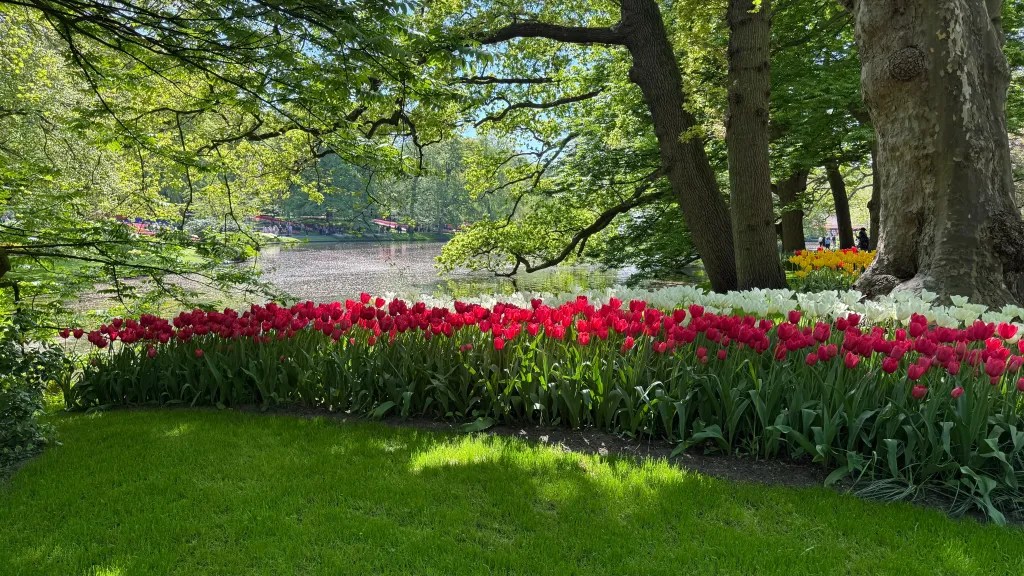
Keukenhof is best understood as a curated showcase rather than a representation of how tulips actually grow in the wild. Open for only a short window each spring, the gardens were created after World War II as a way to promote Dutch bulb growers and have since become one of the most visited seasonal attractions in the country. The displays are immaculate, with carefully designed beds, themed gardens, and an overwhelming variety of flowers beyond just tulips. While it can be busy, crowds felt manageable, and the sheer scale of the grounds allows you to spread out once you move beyond the main paths. You could drive out to Keukenhof independently, but pairing it with a tour like we did simplifies logistics and adds important context that you would otherwise miss.
Bite: Rijsttafel at Tujuh Maret

This was one of the most unique meals of the entire trip and an absolute highlight of our time in Amsterdam. Rijsttafel, which translates to “rice table,” is an Indonesian influenced feast that reflects the Netherlands’ colonial history in Indonesia. Rather than a single dish, it is a spread of many small plates served all at once, meant to showcase a wide range of flavors, spices, and cooking styles. There is no pacing to the meal. Everything arrives together and you dive in. Tujuh Maret does this exceptionally well, delivering both variety and depth of flavor, and it is an experience that feels distinctly tied to Amsterdam. Reservations are essential, and rijsttafel is something we would strongly recommend making room for while in the city.
Highlight: Tulip Bulb Farm in Lisse
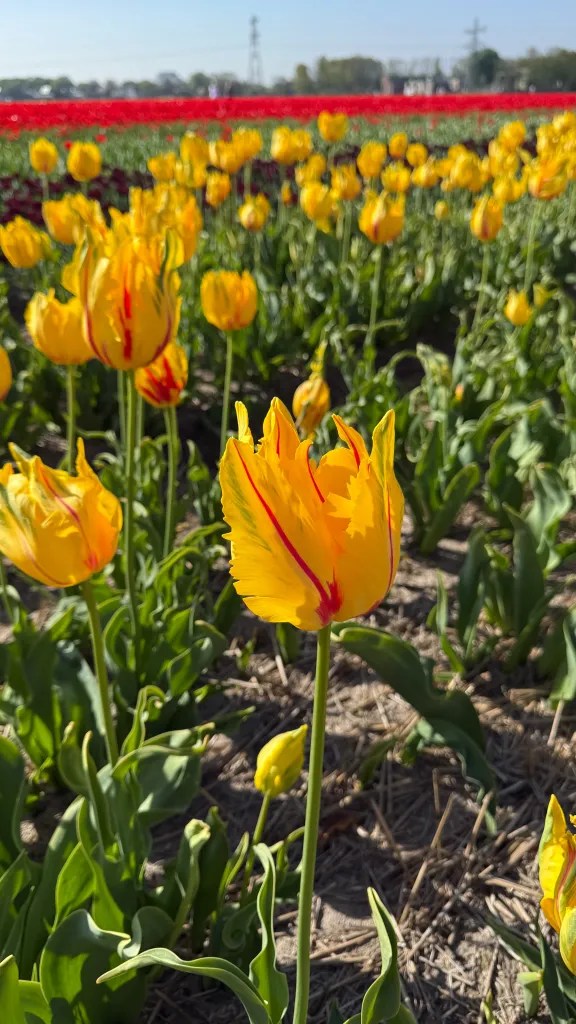
Visiting a working tulip bulb farm was the most visually impactful part of the day. As part of the Tulip Festival package we booked, we were taken directly to a farm in the Lisse area, where growers walked us through how tulips are cultivated and harvested. Being able to walk through the fields offered a level of authenticity that Keukenhof intentionally does not aim to provide. It was quieter, more intimate, and made for incredible photo opportunities. Booking a package like this removes much of the guesswork and guarantees access to a quality farm experience, making it well worth it whether you prefer guided travel or would normally plan something independently.
Day 4: Biking to the windmills




Overview of the Day
Day 4 felt like one of the most distinctly Dutch days of the entire trip. After a few days of cities, canals, and curated tulip experiences, this was the day that tied together windmills, biking, and everyday life in the Netherlands. It was active without being exhausting and offered a glimpse into how people actually live outside of the central city center. More than anything, this day deepened our appreciation for how central windmills and biking remain to Dutch culture.
Sight: Zaanse Schans
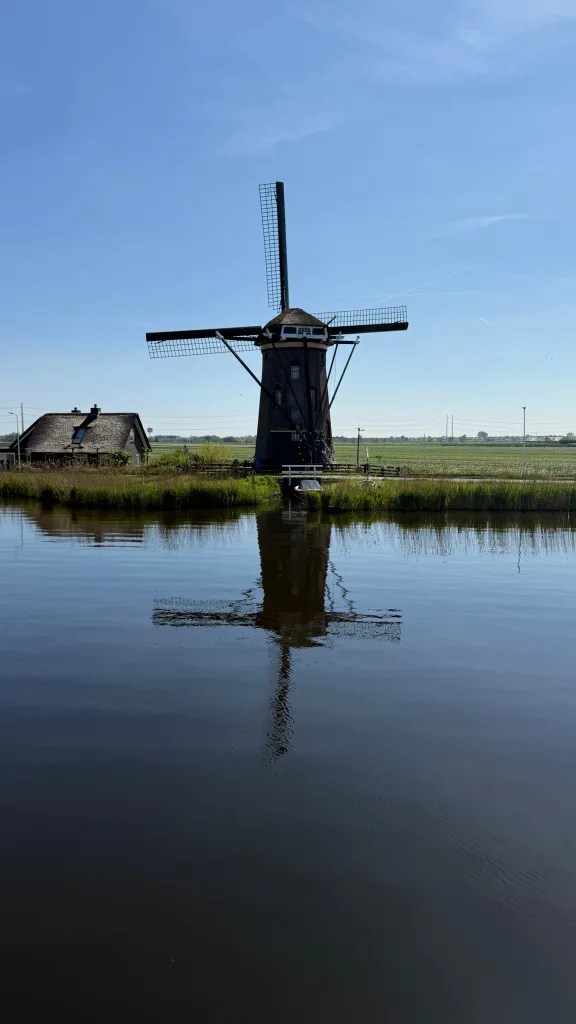
Zaanse Schans is a collection of historic windmills and traditional buildings that were relocated here to preserve them and make them accessible to the public. Historically, this region was one of the first industrial areas in the world, with windmills powering everything from sawmills to oil presses and pigment production. Today, Zaanse Schans exists as an open-air museum of sorts, allowing visitors to walk freely through the area and see working windmills up close. While it is undeniably tourist-facing, it is still absolutely worth visiting. I’d recommend arriving by bike on a guided tour like we did rather than by tour bus, as the bus area felt crowded and chaotic, while arriving by bike allowed us to approach the site easily and then be on our way, enjoying the surrounding landscape along the way. Seen this way, Zaanse Schans feels less like a stop and more like a continuation of the countryside.
Bite: Restaurant De Kas

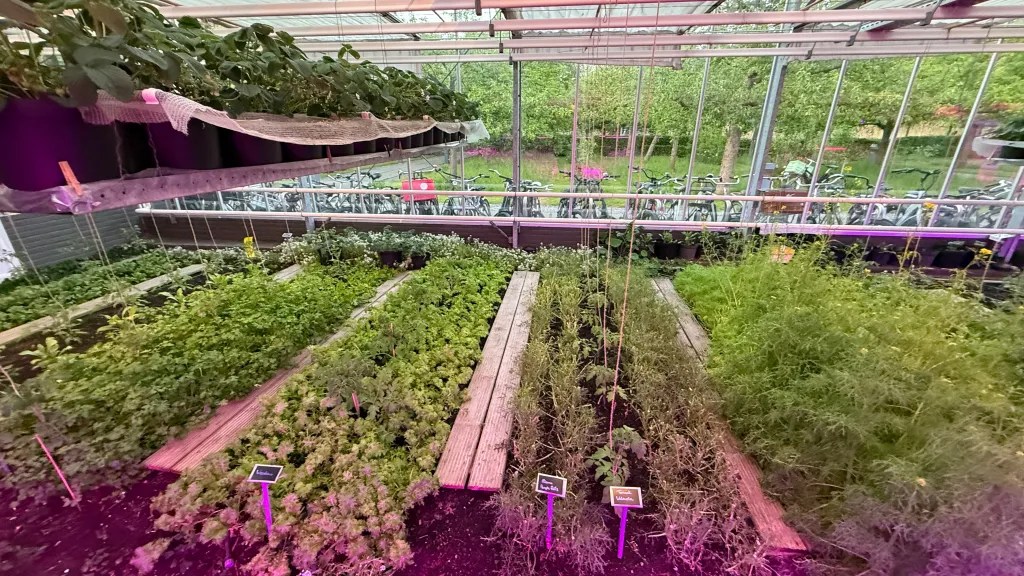
Dinner at Restaurant De Kas was the single best meal of the trip and one of the most memorable dining experiences we have had anywhere. De Kas is a one Michelin star (and green star) restaurant built inside a functioning greenhouse, where much of the produce served is grown just steps from the tables. The menu is driven entirely by what is in season, and the setting makes the connection between food and place impossible to ignore. One of the most fascinating elements was their approach to sustainability, including house-made liquors created from vegetable and fruit scraps. When I asked about it, the person responsible for the fermentations came out with the bottles and walked us through the process, clearly a personal passion project. Midway through the meal, we were encouraged to get up and walk through the gardens, pausing service while we explored. We ended up spending over four hours there, which felt intentional rather than excessive. If you enjoy food and value slow, thoughtful dining, this is a must-do and worth planning around.
My Final Score:
4.563
From The World’s 50 Best List: “Unique in the Netherlands, De Kas is housed in a series of greenhouses dating back to the 1920s. The restaurant grows its own herbs and vegetables and supplements these with quality local produce. The dynamic kitchen team creates one fixed menu daily (three or four courses for lunch; five or six at dinner) based on the season’s harvest. On sunny days, guests can sit outside on the patio in the garden. Small dishes feature simple presentation and fresh, light flavours. A complementary wine list boasts a selection of 40 sustainable wines.”
| Restaurant Name | De Kas |
| Restaurant Location | Amsterdam, NE |
| Google Rating | 4.7 (3,431) – 1/26 |
| Tripadvisor Rating | 4.6 (2,202) – 1/26 |
| Other Rating | YELP 4.5 (187) |
| (If applicable) Michelin Rating | ★☆☆ |
| RATING ELEMENTS | |
| What’s the point? | ★★★★★ |
| Baked Score | ★★★★★ |
| This is the Place | ★★★★★ |
| Taste | ★★★☆☆ |
| Balancing Act | ★★★★★ |
| (Q)onsistent Queen | ★★★☆☆ |
| Showboater | ★★★★☆ |
| Vibe Check | ★★★★★ |
| Nuisance Nuance | ★★★★★ |
| Set the Scene | ★★★★★ |
| Clockwork | ★★★★★ |
| Read the Table | ★★★★★ |
| Wonky Clonky | ★★★★★ |
| Slot Machine | ★★★★★ |
| PvP | ★★★★★ |
| No Ragrets | ★★★★★ |
Highlight: Countryside Bike Tour with Mike’s Bikes
The bike tour with Mike’s Bikes was the highlight of the day and one of the most meaningful experiences of the trip. Riding e-bikes from Amsterdam out to Zaanse Schans allowed us to see parts of the city and suburbs that we would never have encountered otherwise. It was especially interesting to experience suburban Europe, seeing where people actually live and how seamlessly biking is integrated into daily life. The true standout moment came when we stopped at a working windmill owned by a retired man who lives there with his wife. He is a friend of the tour leader and invited us inside, offering an intimate look at the windmill and what it is like to live in one. This kind of personal connection is nearly impossible to replicate on your own and made the experience feel special rather than transactional. The dedicated bike infrastructure throughout the entire ride was impressive and made the journey accessible to anyone, particularly with the power of the ebike. This is not a day we would recommend trying to DIY, the guided experience is what makes it exceptional.
Day 5: Tulip Region by Bike





Overview of the Day:
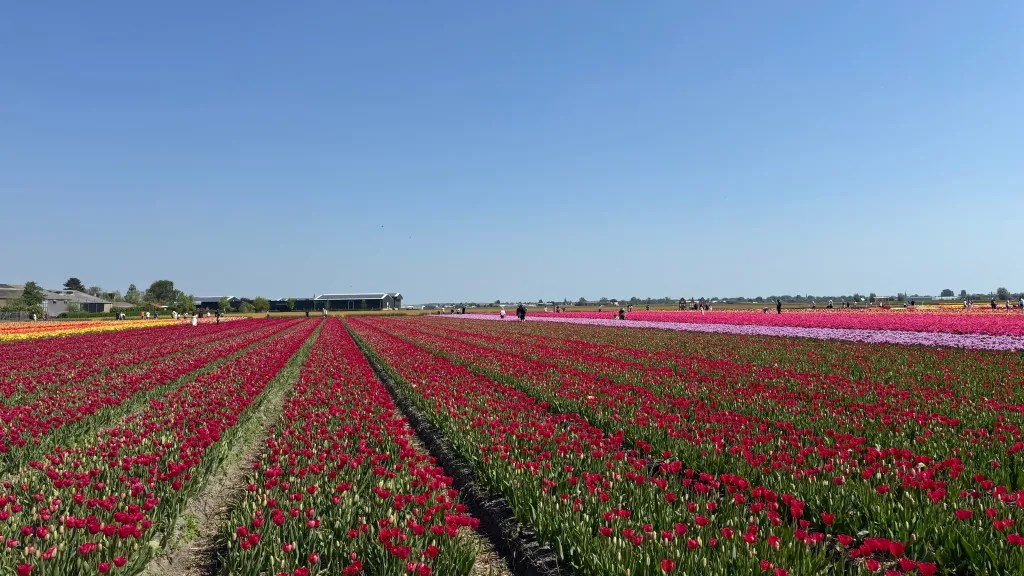
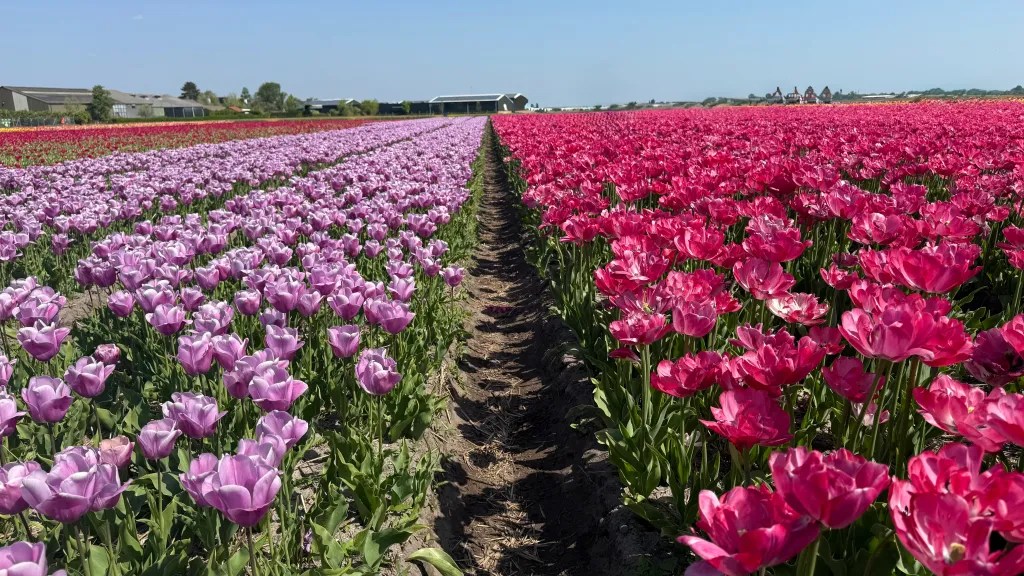
Day 5 felt like the independent counterpart to the tulip experiences earlier in the trip. After seeing the fields through curated gardens and guided tours, this was our chance to explore at our own pace and take in the countryside as we pleased before leaving the tulip region. Three full days in and around Holland for the tulips felt like the perfect amount of time and I would not do less than that. If doing more, I wouldn’t do more than four days before moving along. Despite traveling onward to Bruges later that evening, the day never felt rushed as we were able to see all we wanted on bikes. It was about 6hrs that we had them (10 AM – 4 PM) and the weekend energy made the transition between destinations feel smooth rather than hectic.
Sight: Tulip Fields of the Bollenstreek
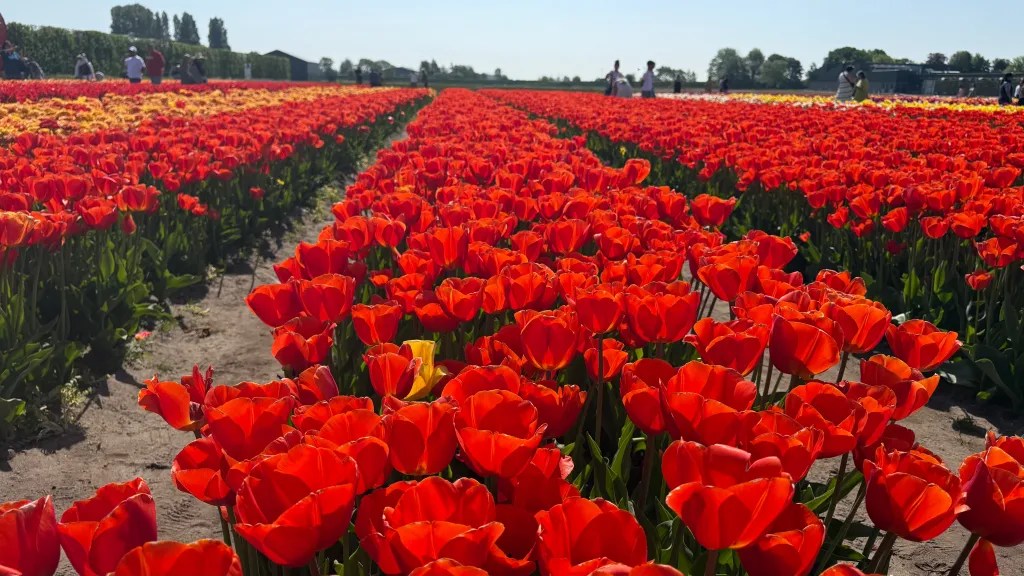
Exploring the tulip fields in the Bollenstreek on our own was a natural extension of what we had already seen earlier in the week. By this point in the season, many farmers had already cut their flowers, which is part of the normal bulb growing process, so the fields were a mix of full color and freshly trimmed rows. That said, there was still more than enough to feel immersed in the landscape. There are a few dedicated flower fields that allow visitors to enter designated areas for a small fee. There are many farms that you admire from the road or sidewalk, as their active agricultural sites for these local farmers. It is important to respect farming etiquette here. These are working farms, not public parks, and visitors should never wander into active fields without permission. We saw a few people do this and it was pretty sad and disrespectful, don’t be that guy. Experiencing the region this way reinforces how agricultural and lived in this landscape really is and, for some farms, feels like you’ve been dipped into the Wizard of Oz’s yellow brick road.
Bite: Fresh Stroopwafel

We stumbled upon fresh stroopwafels at one of the tulip farms, where they were being served alongside bulb sales and other small treats. Stroopwafels are a Dutch staple, something you will see everywhere from street markets to grocery stores, but having them freshly made makes a noticeable difference. Warm, soft, and slightly caramelized, they were the perfect casual snack during a day of biking. This is not a destination food stop so much as an iconic thing to enjoy wherever you find it in the Netherlands. Yes, they’re much better here than on a United flight.
Highlight: Biking Through the Tulip Region
Biking through the Bollenstreek on e-bikes was one of the most enjoyable and accessible experiences of the trip. This was entirely self directed, although there is a good biking tour map that can be followed and stands on the bikes we rented for your phone to help keep directions sound. We were able to stop whenever something caught our eye and move on when we were ready. We even were able to bike out to the beach for a few moments and enjoy some of the Netherlands beach culture (which felt similar to something in like, Carlsbad, CA – not super posh, but nice). The Netherlands’ extensive biking infrastructure makes this kind of day easy, even for travelers who do not bike regularly. Dedicated paths, clear signage, and flat terrain create a stress-free environment, and e-bikes remove any remaining physical barriers. This is a must-do for anyone visiting the region, and – as biking is so popular – it is very easy to find many shops offering full-day bike rentals. I recommend dedicating a whole day to this, with no real itinerary, as it offers a sense of freedom and connection to the landscape, allowing what comes to come, which is hard to replicate any other way.
Delight: Arrival in Bruges with Waffles

Belgian waffles were a recurring delight throughout our time in Bruges and something we actively sought out more than once. It was the best delight for our arrival that evening to Bruges. A proper Belgian waffle is yeast based rather than batter based, which gives it a crisp, structured exterior and a light, airy interior. The key is freshness. You want one made directly on the iron, not something that has been sitting out. If you ask politely, most vendors will happily make one fresh. The result is worth the wait. Warm, fragrant, and lightly crisp, they need very little adornment to shine. Having waffles in Belgium is not optional. It is one of those experiences that lives up to its reputation every time.
Day 6: Bruges


Overview of the Day:
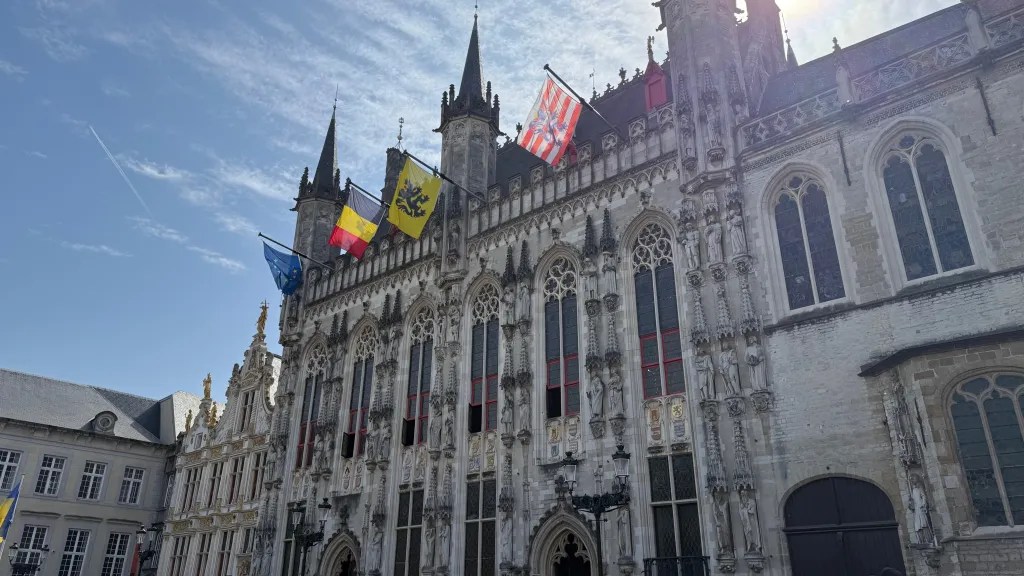
Bruges is an undeniably romantic city, the kind of place that feels carefully preserved without feeling artificial. While smaller than Amsterdam, the pace of the day did not feel slower so much as more contained, with everything unfolding within a compact, walkable core. The city’s scale makes it easy to move from one place to another without effort, but that ease also hides how much there is to take in. By the end of the day, it was clear that Bruges rewards time. This is not a place that should be rushed or treated as a box to check. If anything, it is a city that deserves at one more day if your availability allows and should NEVER be considered a day trip from Brussels. You want to stay a night or two like we did (or three if you want two full days) here.
Sight: Bruges City Center Walking Tour
As with Amsterdam, we started our time in Bruges with a free walking tour, which proved invaluable in understanding the city’s layered history. Bruges was one of Europe’s most important trading cities during the Middle Ages, growing wealthy through wool, cloth, and maritime commerce before its access to the sea slowly silted up and economic prominence shifted elsewhere. That decline, paradoxically, helped preserve its medieval core. The tour walked through key landmarks including Market Square, the Belfry, the canals, and former guild houses, explaining how Bruges’ prosperity shaped its architecture and layout. One detail that stood out was the frequent appearance of the half moon symbol throughout the city, which the guide explained is tied to the De Halve Maan brewery and its long history in Bruges. Today, beer from the brewery is famously transported through underground pipelines beneath the city, a modern solution designed to preserve the historic streets above.
Bite: Belgian Frites and De Halve Maan

Eating frites in Belgium is less about finding the best fries and more about participating in a cultural ritual. Belgian frites are thick cut and double-fried, producing a crisp exterior and fluffy interior, and are traditionally served with a wide selection of sauces. The quality is consistently high, and it is easy to understand why this food holds such an important place in Belgian identity. We paired our frites with a stop at De Halve Maan, which is an absolute must visit in Bruges. The brewery has been family-run for generations and offers excellent beer, good food, and a lively atmosphere especially in their courtyard on a nice day for Lunch.
Highlight: Wandering Bruges
The highlight of the day was unstructured wandering, particularly in the late afternoon as the city began to transition toward evening. About an hour before sunset turned out to be the ideal window. By then, most of the large walking tours had finished, but the nighttime tours had not yet begun, and the city noticeably quieted. This made it the perfect time to cross the smaller bridges, walk along the canals, and linger in parks without the crowds that dominate midday. Bruges is extremely popular with day trippers, and while it is beautiful at any hour, it truly shines once that wave recedes. This is not a city that should be visited on a tight schedule. Wandering without an agenda, especially as the light softened, was when Bruges felt most romantic and rewarding.
Day 7: Return to London


Overview of the Day:
Day 7 felt like a celebratory and intentional way to close out the trip. Returning to London after several days in the Netherlands and Belgium felt familiar rather than jarring, and it reinforced how much we enjoy using London as both a starting and ending point for European travel. There is something satisfying about easing into a trip with a city you know and then coming back to it at the end with a different perspective. I would also say, for first timers, London deserves a trip in and of itself, with at least 4 days dedicated to the city. So, I would only do this if I had visited London before. If not, then flying directly in and out of Amsterdam would have allowed for an extra day in Bruges or a stop in Brussels and would be appropriate. That said, we genuinely enjoyed the rhythm of bookending the itinerary with London and would highly recommend do it this way again as long as you’re ok with a little switch up at the beginning and end.
Sight: Borough Market
Borough Market is a non negotiable stop when visiting London, and it continues to evolve while still honoring its roots as one of the city’s oldest food markets. Dating back more than a thousand years, it began as a wholesale market serving London and today operates as a showcase for standout producers and prepared food vendors. Some stops have become almost ritual. Turnips is famous for their chocolate dipped strawberries, which are consistently excellent and somehow always worth the line. Brindisa is the go to for Spanish food, especially their paella, which is one of the most popular hot dishes in the market. Kappacasein remains legendary for its grilled cheese, drawing a constant crowd, while Bread Ahead is known for its filled donuts and baked goods. The Ginger Pig is a must for sausage rolls and meat pies, and Roast serves classic British sandwiches like roast beef and porchetta. You will also find excellent seafood, including fish and chips and fresh oysters, along with high-quality coffee, cheese, and chocolate stalls throughout. It is crowded and chaotic, especially midday, but absolutely worth it. Be prepared to eat standing up, leaning against a wall, or sitting on the curb nearby. Borough Market works just as well for repeat visits as it does for first timers, and it remains one of the best places in London to sample a wide range of the city’s food scene in one stop.
Bite: Bao (Mary)
Dinner at Bao was exceptional and easily one of the standout meals of the London portion of the trip. BAO (multiple locations, we went to Mary) specializes in Taiwanese style steamed buns, which are soft, pillowy bread pockets typically filled with rich, savory ingredients – called Bao! The concept is simple, but when done well, it is incredibly satisfying. Bao has earned widespread acclaim in London for both its food and atmosphere, and it lives up to the reputation with the original soho location making the Michelin Guide. The restaurant balances a lively, energetic vibe with consistently excellent execution, making it feel special without being overly formal. This was a planned reservation and well worth it. This highlights an element of London, which is the food. Although traditional English food can be, in my opinion, hit or miss – London has some of the best international foods. From Indian to Taiwanese Bao there is no shortage of good meals in London.
My Final Score:
4.321
From Time Out London: “Since it flung open the doors of its first restaurant in 2015, Bao has become a lowkey London institution. After almost a decade of fluffy buns and basement karaoke, the notoriously tasty Taiwanese mini chain is on its way to being as synonymous with eating out in the capital as St John, The Savoy Grill and a hasty but hallowed Pret baguette scoffed while striding through Soho Square to the pub on a sunny summer’s evening.”
| Restaurant Name | Bao Marylebone |
| Restaurant Location | London, UK |
| Google Rating | 4.7 (1,575) – 1/26 |
| Tripadvisor Rating | 4.2 (983) – 1/26 |
| Other Rating | Time Out 4/5 |
| (If applicable) Michelin Rating | Bib Gourmand |
| RATING ELEMENTS | |
| What’s the point? | ★★★★☆ |
| Baked Score | ★★★★★ |
| This is the Place | ★★★★★ |
| Taste | ★★★★★ |
| Balancing Act | ★★★★★ |
| (Q)onsistent Queen | ★★★★☆ |
| Showboater | ★★★☆☆ |
| Vibe Check | ★★★★☆ |
| Nuisance Nuance | ★★★☆☆ |
| Set the Scene | ★★★★☆ |
| Clockwork | ★★★☆☆ |
| Read the Table | ★★★★★ |
| Wonky Clonky | ★★★★★ |
| Slot Machine | ★★★★★ |
| PvP | ★★★★★ |
| No Ragrets | ★★★★★ |
Highlight: Football Match at Emirates Stadium
Seeing a football match at Emirates Stadium was the highlight of the day and an unforgettable way to end the trip. While we are not newcomers to live football, we are to being in the lower bowl with singing supporters and the atmosphere here stood out. We purchased tickets through StubHub on the day of the match, which technically operates in a gray area, but the advantage of day-of purchases is having certainty, as stubhub will show you that they are verified tickets and send you a PDF of the ticket shortly after purchase. We ended up seated in a long time Arsenal supporter section in the lower bowl, just behind the goal, where the crowd energy was constant. Everyone was standing, singing, and fully engaged for the entire match. Paying attention to the chants and joining in dramatically enhanced the experience. The atmosphere in these lower sections is where the magic happens, and it is worth splurging for immersion rather than opting for higher, quieter seats. Even for those who are not die hard fans, the communal energy alone makes attending a match well worth it.
Like this itinerary? How to book:
This trip took place from April 26 through May 4, which we would absolutely recommend for a tulip focused itinerary like this. Tulip season in the Netherlands is short, typically lasting four to six weeks from late March through early May, and true peak bloom is unpredictable year to year. Late April into early May strikes a strong balance. There is still plenty of color in the fields while everything across the country is fully open for the season and weather is more favorable. This timing also benefits from long daylight hours and comfortable spring weather, making it ideal for walking and biking. That said, still expect rain and, we felt that we were there really on the last few days of good viewing season and certainly missed the “prime” which was the week before. However, people told us that it was raining all day every day the week before so, “prime” here is subjective. We would much rather take the more predictable good weather and reduced amount of tulips but some may prefer to risk weather a bit more for more full tulip fields.
So, with that in mind, I think the biggest thing to remember about this trip is that tulips are only part of the appeal. Many fields may already be cut by early May, which is normal, as growers remove flowers to strengthen the bulbs. This itinerary works best for travelers who are flexible, curious, and interested in understanding how tulip farming actually works, not just seeing flowers at peak Instagram moments. If you’re searching for peak tulips, I recommend going a bit earlier and being ok staying longer so that you can time it while there, in country. You will also need to book airfare, hotels, etc. at a different pace as you’ll want to wait until about 30 days out to time it perfectly.
I recommend this itinerary for travelers who are comfortable walking and biking, moving between destinations, and maintaining a full but intentional pace. Seven days felt ideal. You could add an extra day in Bruges or Amsterdam if you wanted a slower rhythm, but we would not shorten it much further without losing the balance between cities, countryside, and tulip experiences.
Step 1: Book Flights [120 – 180 days out]
For this trip, we flew into London Heathrow (LHR) and out of London Heathrow, rather than flying directly into Amsterdam. We found an excellent points and miles redemption on a nonstop flight from Salt Lake City to London, which made this routing worthwhile. While London is not the primary destination for this itinerary, it works extremely well as both a starting and ending point due to its flight availability and high speed rail connections.
From London, Amsterdam is easily reached via direct Eurostar high speed train, making the transition simple and efficient. This routing also allowed us to bookend the trip with time in a city we love. That said, if maximizing time in the Netherlands and Belgium is your priority, flying directly into and out of Amsterdam Schiphol would allow for an additional day elsewhere.
Common flight routing options to consider:
- USA → LHR | LHR → USA (combine London with the itinerary, strong flight availability)
- USA → AMS | AMS → USA (most direct, best if skipping London – particularly good availability at Delta Hubs as KLM and Delta are in the same alliance)
- USA → CDG | AMS → CDG (Shorter train than London, while still direct and via the Eurostar network. Essentially changing London for Paris)
- Open jaw options if mixing cities, depending on airfare and points availability
If you’re flying KLM or AirFrance, be sure to note that the type of plane you fly makes a difference. Many of their widebodies are arranged in 3x3x3 in economy (vs. Delta’s common 2x4x2). So, depending on how many travelers, this may be a pro or con to you. Changing times will rarely change the plane. If you want to fly a different plane, you’ll need to look at flying out of a different hub city.
Step 2: Book Hotels [90 – 120 days out]
Look at my individual hotel reviews in the blog to determine if they are right for you before booking.
| Trip Nights | City | Hotel | Method |
|---|---|---|---|
| 1 | London | The Waldorf Hilton | Hilton Points via Hilton: BOOK |
| 2, 3, 4 | Amsterdam | DoubleTree Amsterdam Centraal Station | Hilton Points via Hilton: BOOK |
| 5, 6 | Bruges | Hotel Dukes’ Palace | Via Capital One Portal or Direct: BOOK |
| 7 | London | Lost Property St Paul’s, Curio Collection | Hilton Points via Hilton: BOOK |
Step 3: Transportation and Activities to book in advance [30 – 60 days out]
Long Train Legs
This itinerary relies heavily on trains, and booking key routes in advance will save both money and stress. We booked all long-distance rail through the Eurostar website, which worked well for managing tickets across countries.
Routes to book in advance:
- London → Amsterdam (Eurostar, direct, seat reservation required)
- Bruges → Brussels → London (Eurostar from Brussels)
High-speed trains can sell out or become expensive closer to travel, especially on weekends, so this is not something to leave until the last minute.
Tulip Festival Experience Package
I strongly recommend booking a Tulip Festival package that includes transportation, a visit to a working tulip bulb farm, canal sailing in the Lisse area, and entry to Keukenhof. This guarantees access to a high-quality farm experience and removes much of the logistical complexity.
These bookings can be found at the official Tulip Festival Amsterdam website.
Bike Reservations: Independent & Tour
There are two biking components to this itinerary, and both benefit from advance planning.
- Guided bike tour to windmills was one of our favorites and must be booked in advance.
- Independent biking day in the Bollenstreek: For the self-guided tulip field biking day, I recommend reserving e-bikes in advance, particularly during tulip season when demand is high. Rentals near stations like Hillegom are limited, and showing up without a reservation can mean missing out. We booked from here but there are many options.
Restaurant Reservations: De Kas, Tujuh Maret
Several of the best meals on this itinerary require planning.
- Restaurant De Kas (Amsterdam): Reservations should be made at least 2–3 weeks in advance, especially for dinner. This was one of the most memorable meals of the trip and absolutely worth planning around. Reserve Here
- Tujuh Maret (Rijsttafel, Amsterdam): Reservations are essential, particularly for evenings. Rijsttafel is popular, and this restaurant books out regularly. Reserve Here
Guided and free walking tours (reserve a spot in advance)
We almost always start time in a new city with a walking tour, and this itinerary includes multiple ones.
These tours operate on a tip-based model, but you should still reserve a spot online in advance, especially during peak season. Groups are capped, and walk-ups are not guaranteed.
Important museum warning: Anne Frank House and Van Gogh Museum
We did not visit either the Anne Frank House or the Van Gogh Museum, not by choice, but because we did not secure tickets early enough. These are two of the most competitive tickets in Amsterdam, and walk-up entry is not an option.
- Anne Frank House: Tickets are released online only, typically six weeks in advance at midnight Amsterdam time and sell out very quickly. There are no same-day tickets at the door. If this is a priority, you need to plan around the ticket release schedule and book immediately.
- Van Gogh Museum: Tickets are sold as timed entry and should be booked several weeks in advance during spring and summer. Same-day availability is rare during peak season.
If either museum is important to you, build your Amsterdam days around these tickets rather than trying to fit them in later.
Step 4: iTEMS YOU WILL BOOK WHILE ON THE TRIP
| Item | City | What to Know |
|---|---|---|
| Amsterdam → Bruges train (via Antwerp) | Netherlands / Belgium | We booked this route the day before travel using the NS International app. Trains run frequently and advance booking far ahead is not necessary. |
| Canal cruise | Amsterdam | Easy to book same day or day before. Lots of options and not essential, but a fun and inexpensive way to see the city if the weather is good. |
| Football tickets | London | Same-day resale can work for confirmed seats if official tickets are unavailable. You can also book in advance via stubhub but run a risk of tickets not being confirmed. |
Step 5: Daily flow
| Day | AM | Late AM | PM | Late PM | Evening |
|---|---|---|---|---|---|
| 1 (London) | Arrive LHR | Hotel Check In | Afternoon Tea | Stroll Covent & Casual Dinner | West End Theatre |
| 2 (Amsterdam) | Eurostar to AMS | Walking Tour | Canals Strolling / Museums | Explore City | Dinner + Red Light |
| 3 (Amsterdam) | Tulip Package Tour | Bulb Farm | Canal Sail | Keukenhof | Rijsttafel Dinner |
| 4 (Amsterdam) | Bike Tour | Zaanse Schans | Bike Tour | Canal Cruise | Dinner (De Kas) |
| 5 (Amsterdam) | Bike Bollenstreek | Bike Bollenstreek | Free (Museums) | Train to Bruges | Waffles! |
| 6 (Bruges) | Walking Tour | Walking Tour | De Halve Maan Lunch | Food Stops (Chocolate, Frites, etc) | Canal Cruise, Dinner |
| 7 (London) | Trian to London | Borough Market | London Strolling / Landmarks | Football Match | Dinner (Bao) |
| 8 (London) | Elizabeth Line to LHR | Fly Home |
STep 6: Tips, Tricks, and Things to Know
- Tulip timing is never perfect: Tulip season is short and highly dependent on weather. Some fields will be in peak bloom while others will already be cut, especially later in the season. This is normal and part of how bulb farming works. Go for the experience and the understanding of the process rather than chasing perfection.
- Respect tulip farming etiquette: Tulip fields are working farms, not public parks. Never walk into active fields unless explicitly allowed. Many farms offer designated walking paths or paid entry areas, which are the appropriate way to experience the fields up close. Respecting this keeps the landscape sustainable and accessible for future visitors.
- Biking is essential and accessible: The Netherlands is exceptionally bike friendly, with dedicated lanes, clear signage, and flat terrain. E-bikes make distances manageable for most travelers, even those who do not bike regularly. That said, biking culture is taken seriously. Stay in bike lanes, signal turns, and remain aware of faster riders.
- Guided versus independent experiences: This itinerary works best with a mix of both. Guided experiences, like the tulip farm visit and windmill bike tour, provide access and context that are difficult to replicate on your own. Independent days, like biking the Bollenstreek, allow flexibility and deeper immersion. Both are worth including but doing the guided experiences first will help you understand what is going on through the independent so, start with a guide.
- Book key meals intentionally: Some of the most memorable meals on this trip required planning. Restaurant De Kas and rijsttafel dinners book out well in advance and are worth building your days around. Long lunches and later dinners pair best with active sightseeing days.
- Amsterdam museums require advance planning: If the Anne Frank House or Van Gogh Museum are priorities, tickets must be secured well in advance. There are no walk-up tickets for Anne Frank House, and Van Gogh Museum availability is limited during spring. Plan your Amsterdam days around these tickets rather than trying to fit them in later.
- Bruges is not a day trip: While Bruges is often visited as a day trip, staying overnight completely changes the experience. The city becomes far more enjoyable once day trippers leave, particularly in the late afternoon and early evening. If possible, prioritize at least one overnight stay.
- London works well as a bookend but is not recommended if you’ve never been to London: Using London as both a starting and ending point adds flexibility, flight availability, and a strong sense of rhythm to the trip. High speed rail connections make this practical, and it allows you to combine familiar comforts with new destinations. However, London was very fun as a bookend since we’ve been before. I think it would be a little too much if you were doing this without having been. I would recommend extra time to take in London (I think 4 days in London is perfect) before going to Amsterdam (or after you get out of Amsterdam) if you haven’t been. Either that, or round-trip travel in/out of AMS or Brussels is great.
- Pack for spring variability: Spring weather can shift quickly. Bring light layers, a waterproof jacket, and comfortable walking shoes (both for walking and biking). Expect sun, wind, and occasional rain, sometimes all in the same day. Remember, you’ll be biking, so leggings/biker shorts and active wear for that are recommended for the two biking activities.